Blood Wedding
Federico García Lorca, 1932
Bodas de Sangre — A Tragedy in Three Acts and Seven Scenes
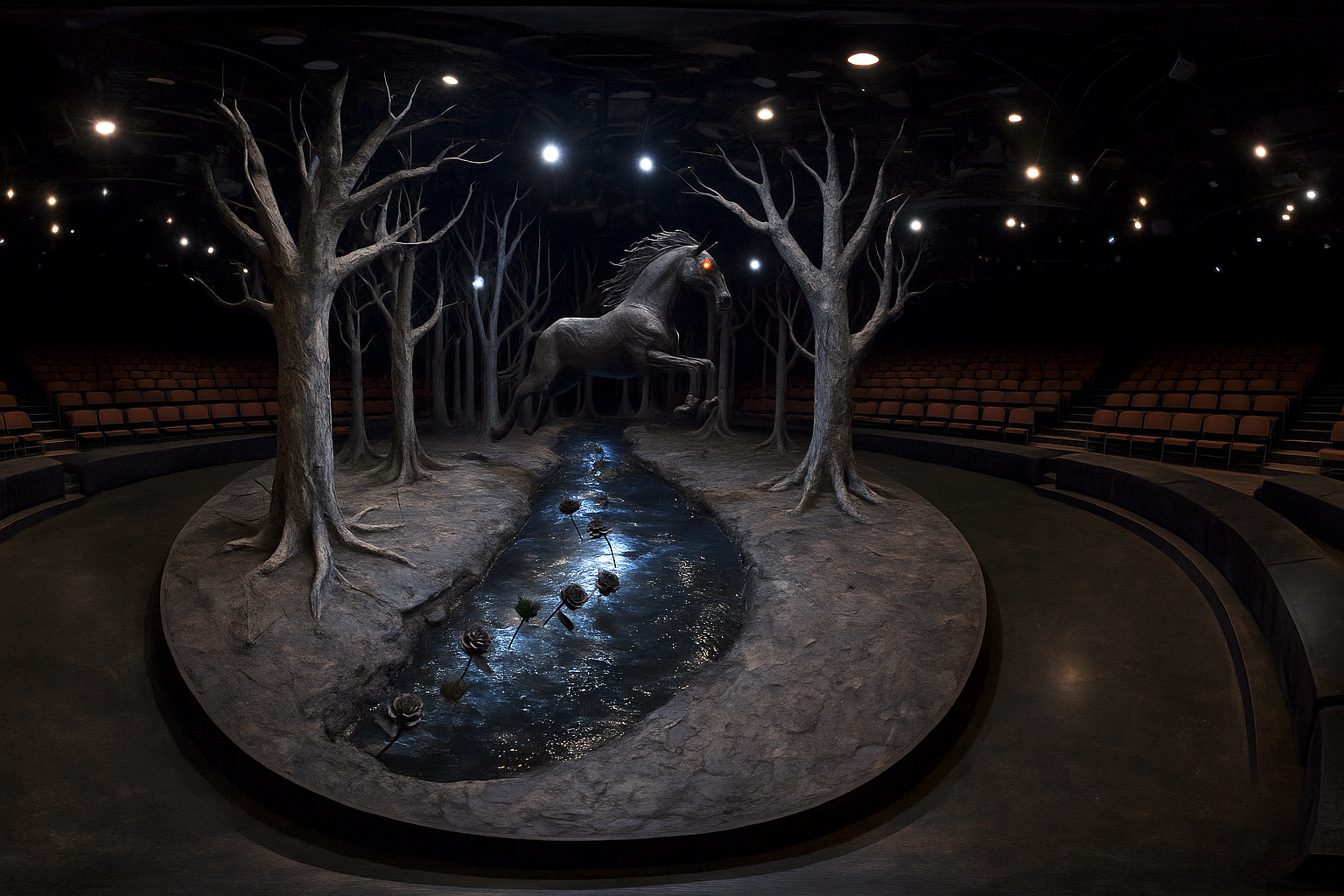
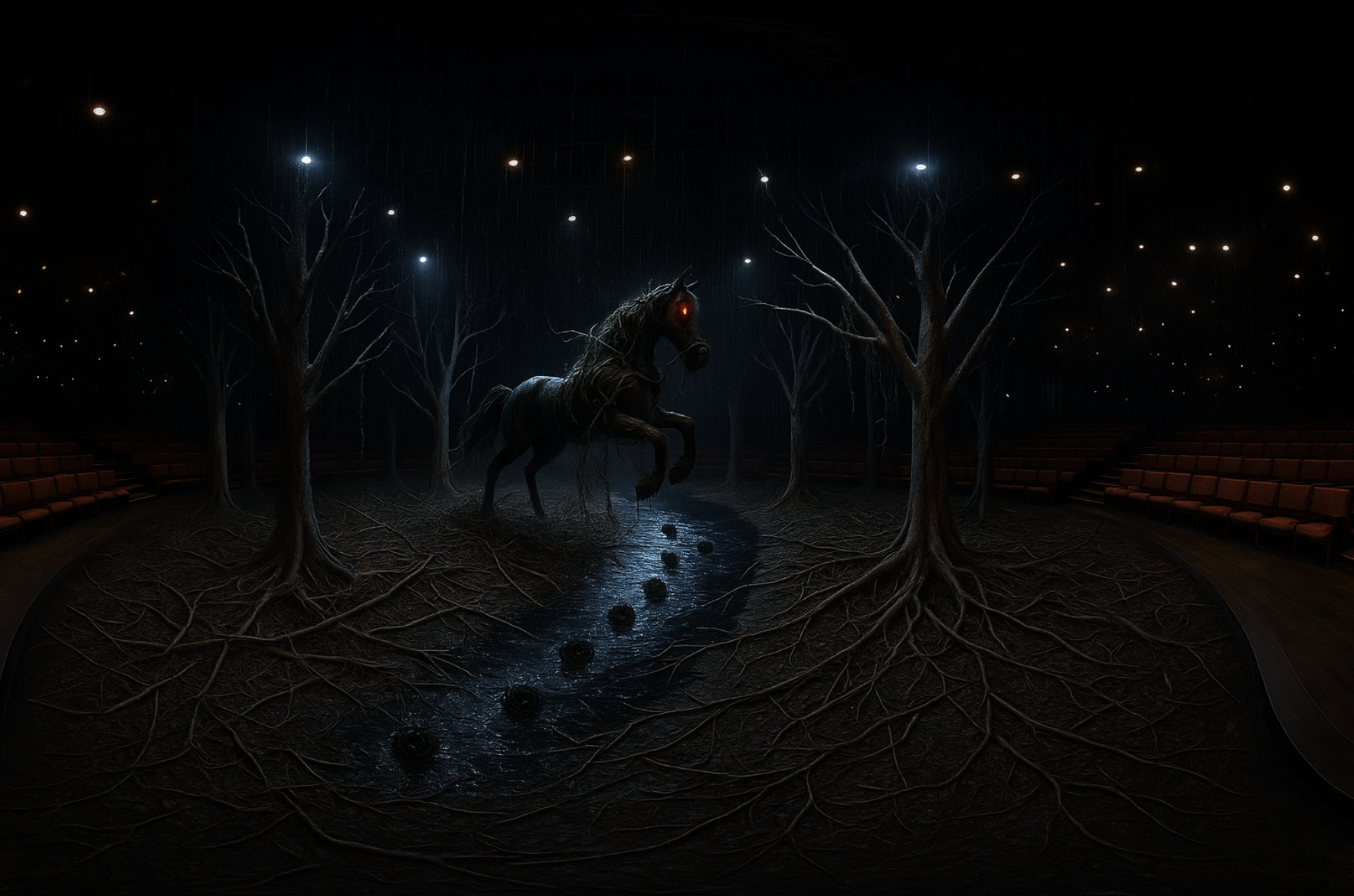
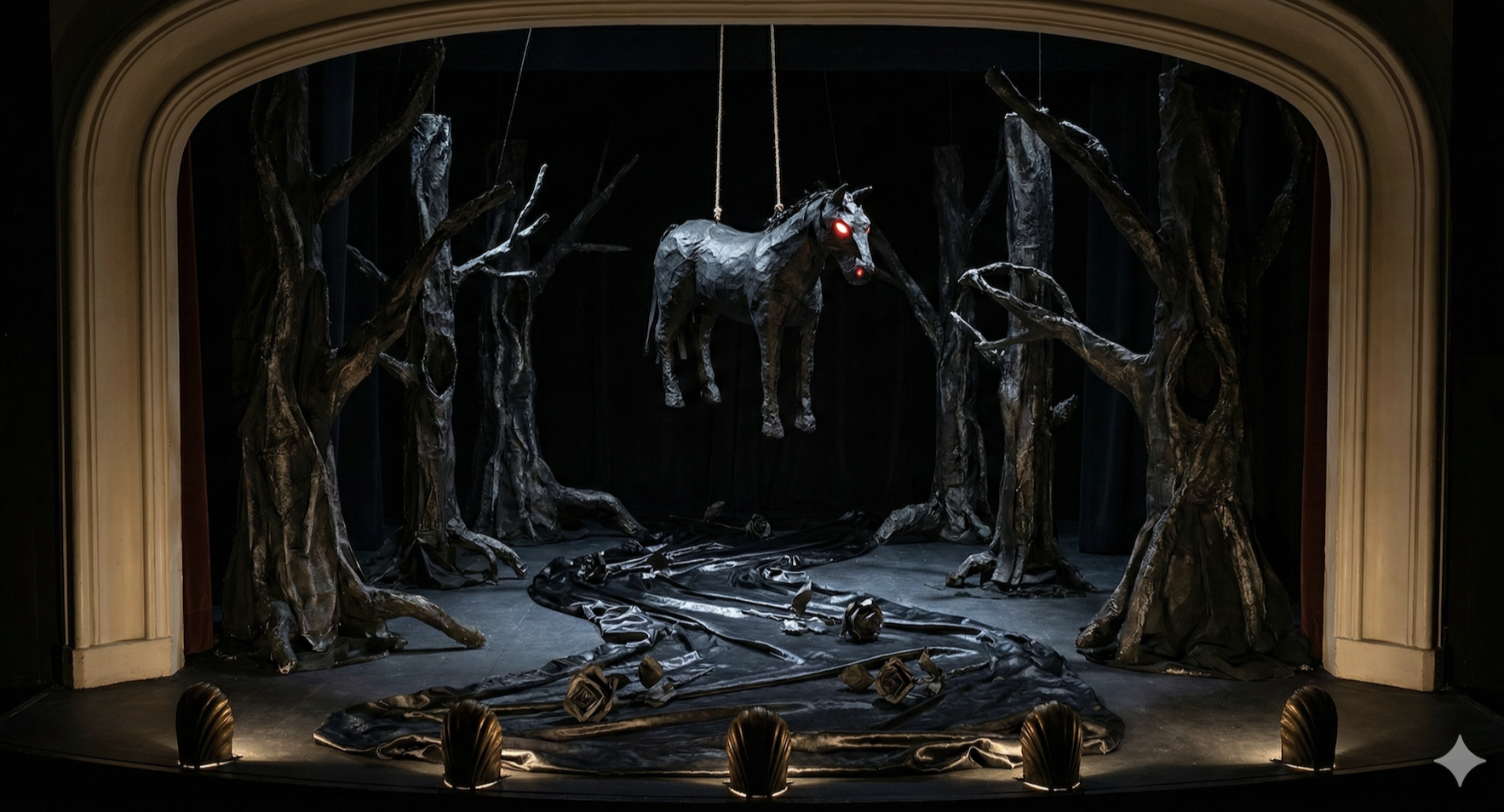
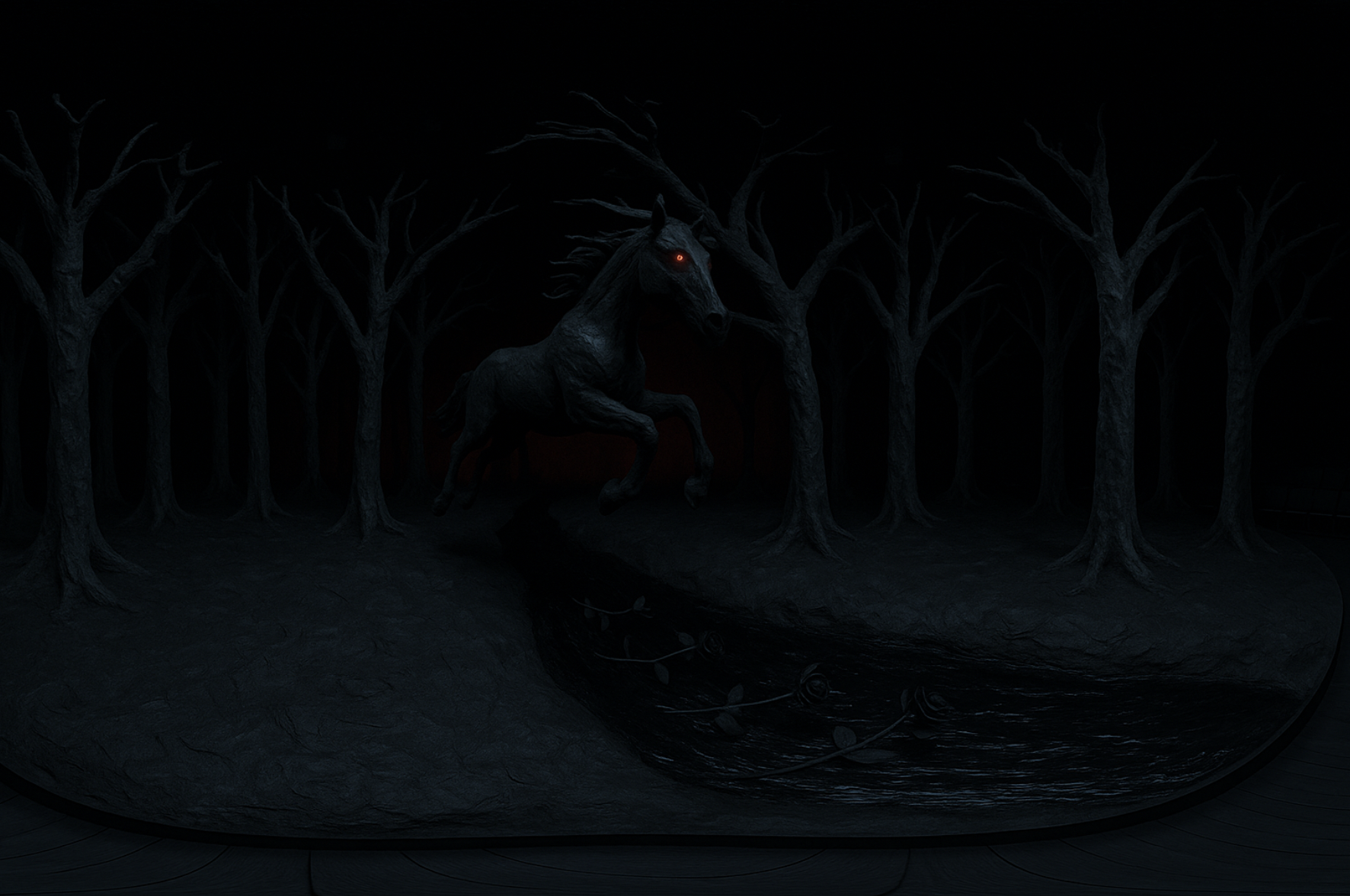
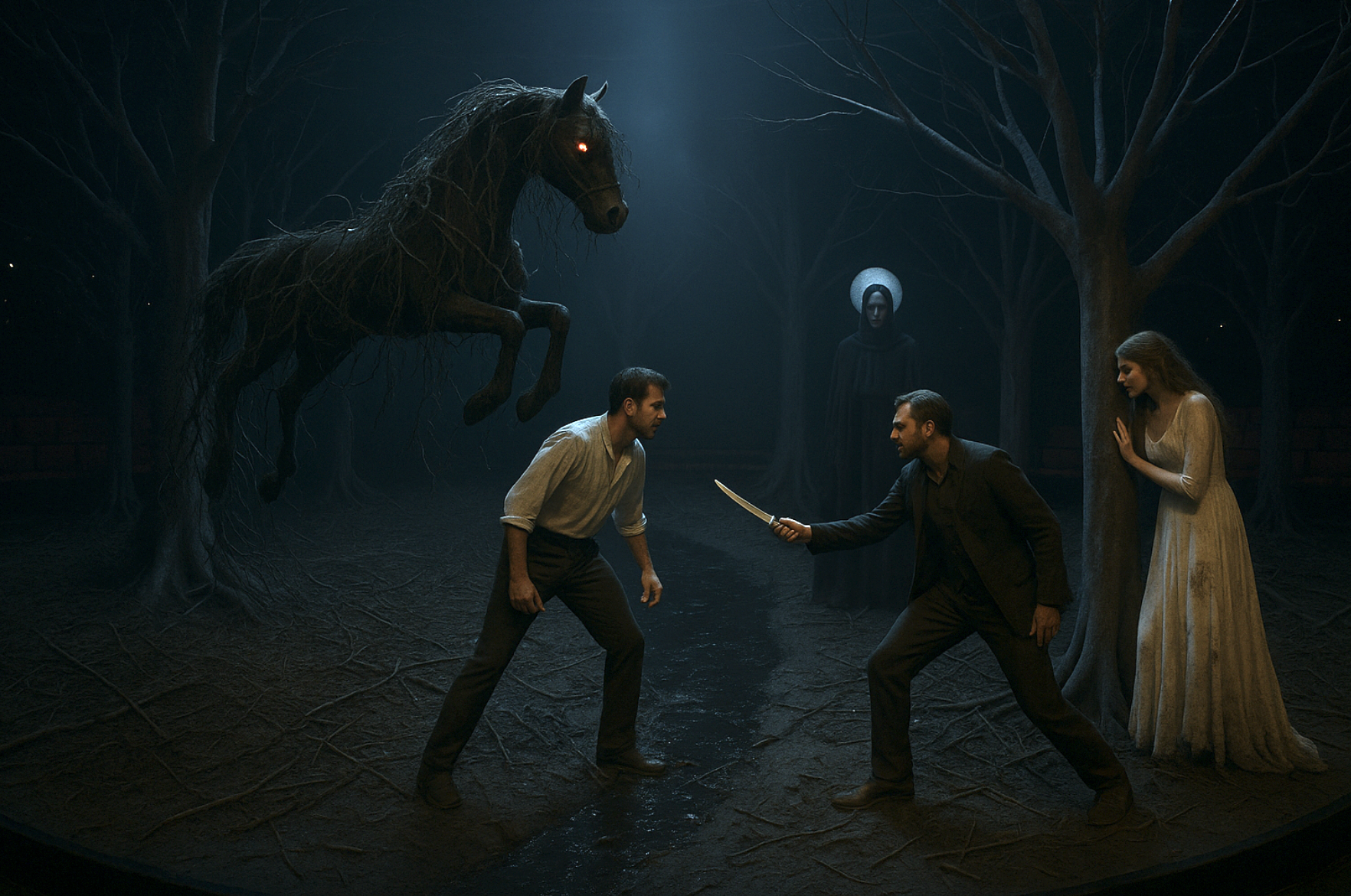
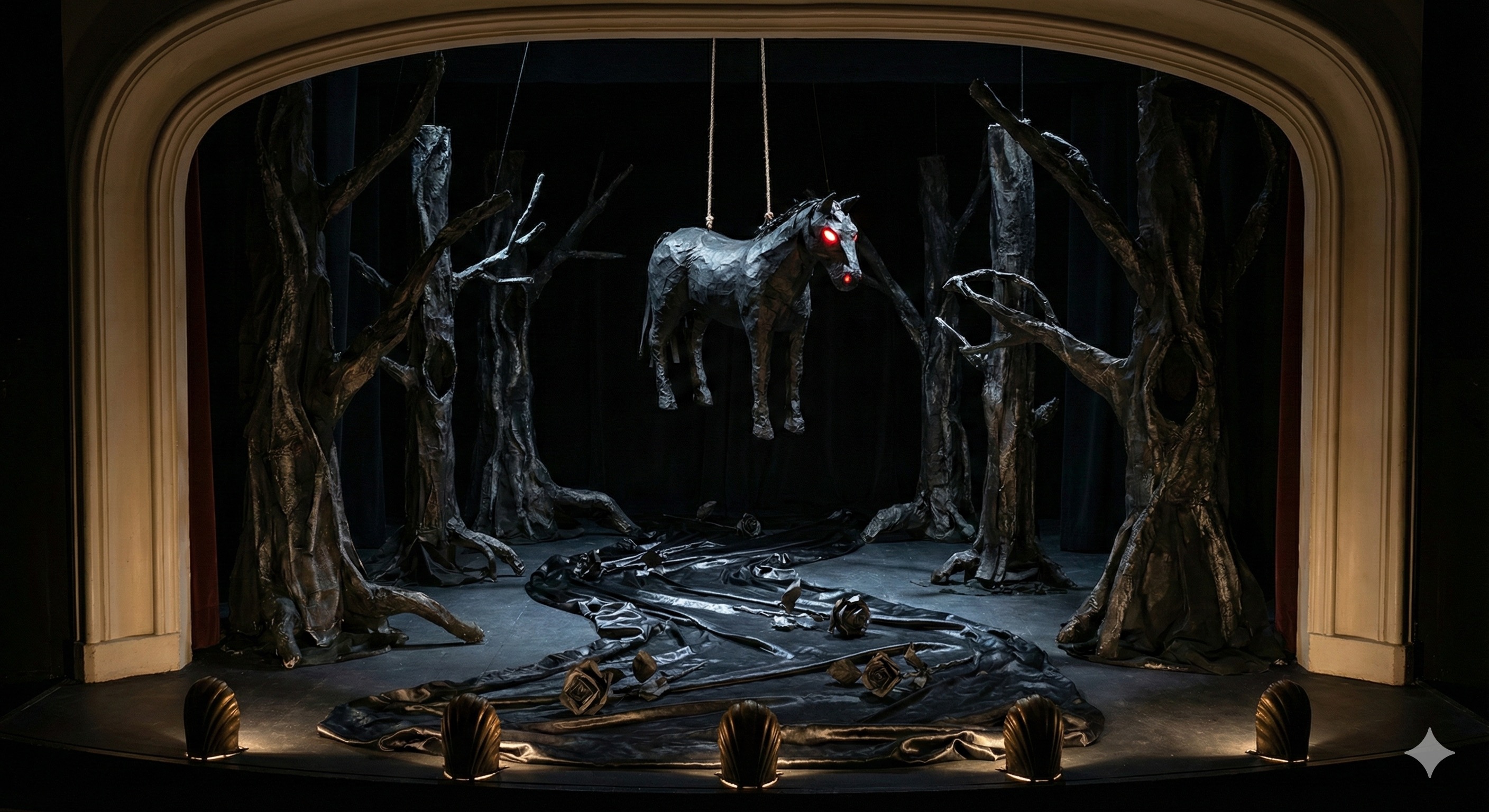
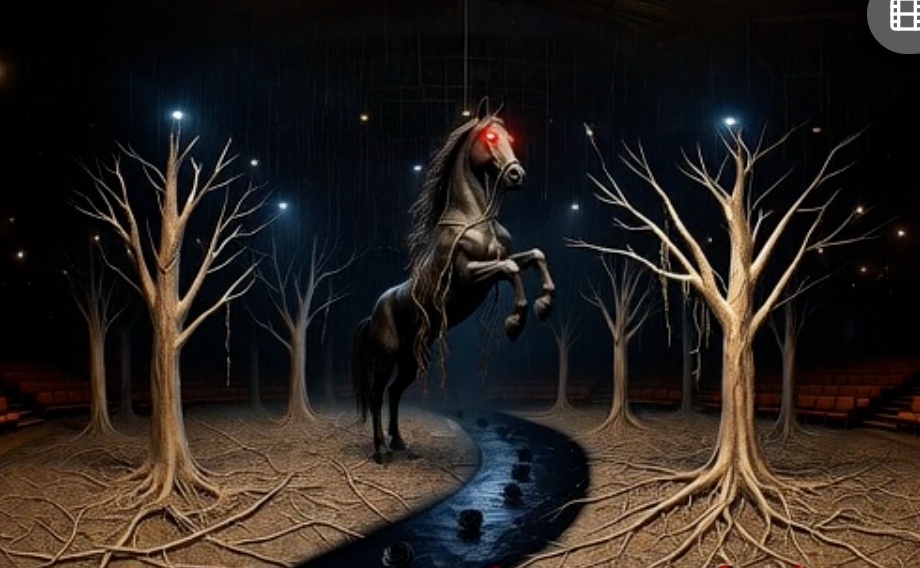
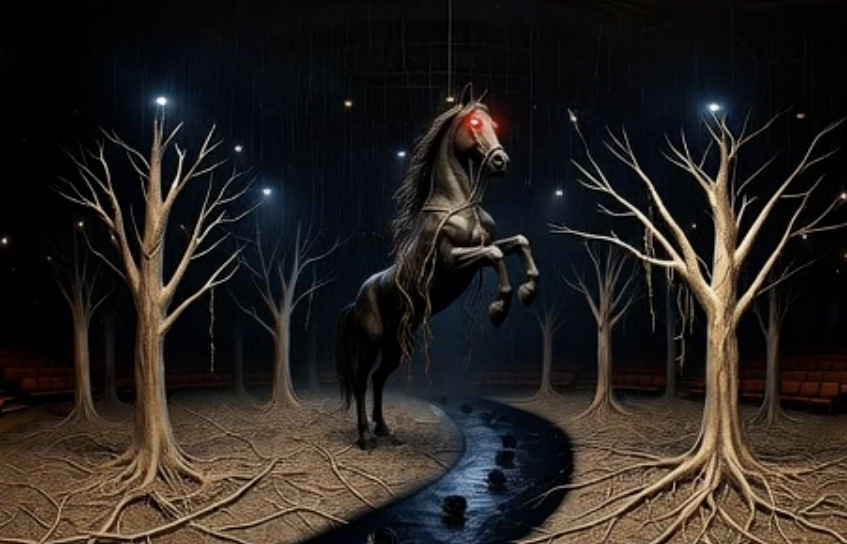
A theatre-in-the-round production set within a dark paper-mâché forest. Black rose stalks float downstream through a glowing river that bisects the stage. Above, suspended mid-gallop from a gnarled branch, a paper-mâché black stallion with fiery red eyes watches over the unfolding tragedy.
This is the horse that Death rides in Act III—frozen in eternal motion, a harbinger made material. The forest grows denser through each act until it consumes everyone.
Design Concept
The forest as fate. Lorca's tragedy moves inexorably toward violence in the woods—the place where the Bride and Leonardo flee, where the Bridegroom pursues, where Death waits disguised as a beggar woman. This design makes the forest present from the first moment, surrounding the audience, growing closer with each act until escape becomes impossible.
The Space
Theatre-in-the-round with the audience seated among paper-mâché trees. The forest isn't a backdrop—it's the architecture of the space itself. Gnarled black trunks rise from the floor, their branches reaching over the audience's heads.
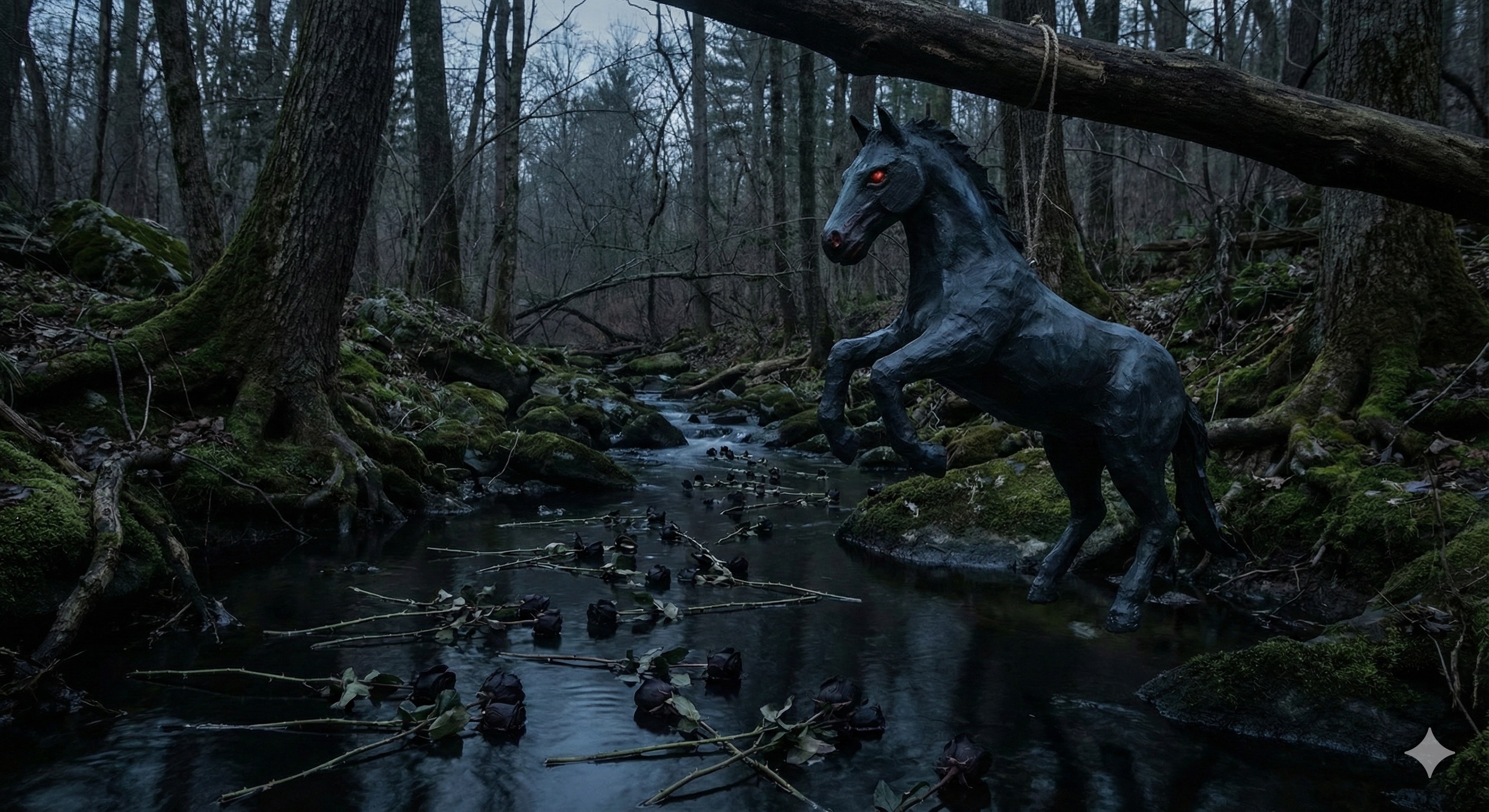
A stream of black water runs stage left to right, its surface catching coloured light from below. Black rose stalks and petals float downstream throughout the performance—the accumulated debris of the play's symbolism, physical evidence of passion bleeding out.
The Suspended Horse
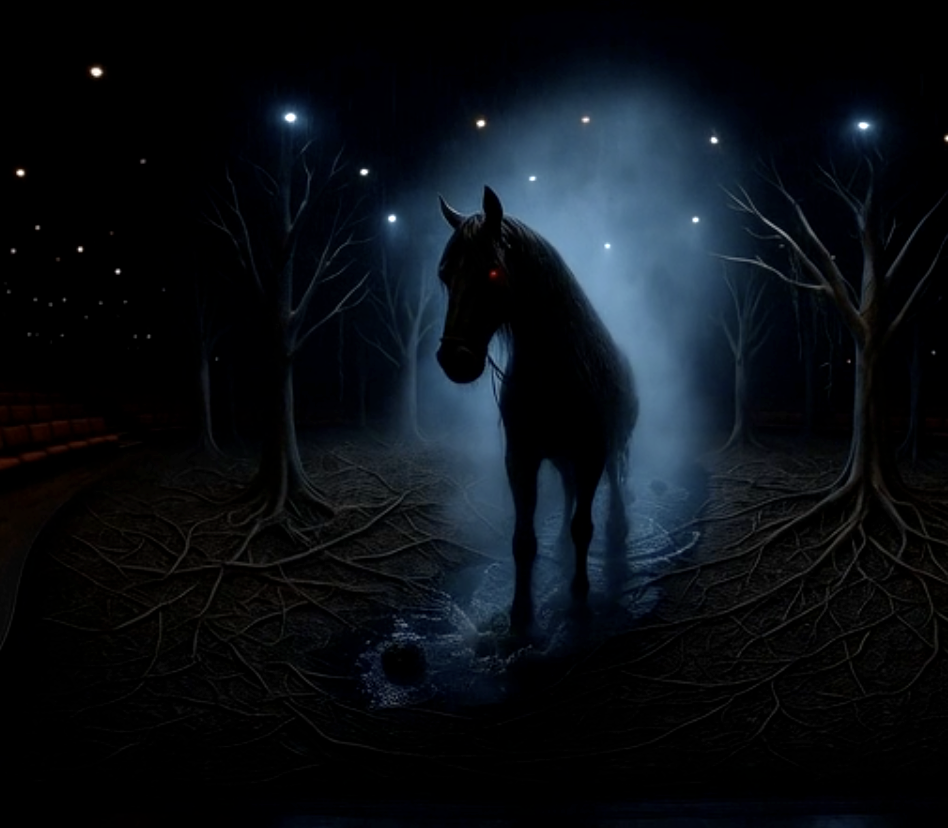
Above the stage, caught mid-gallop, a life-size paper-mâché black stallion hangs from a dead tree branch. Its eyes glow faint red—practical LEDs embedded in the sculptural form. This is the horse Leonardo rides obsessively, the horse that carries him to the Bride, the horse that Death will mount in Act III.
The horse never moves. It doesn't need to. Suspended in eternal motion, it watches everything unfold below with those burning eyes. When the Moon rises in the final act, the horse's eyes flare brighter.
Lighting Concept
Act I: Warm amber from oil lamps and candles. Domestic interiors carved out of the forest through pools of light. The trees visible at the edges, waiting.
Act II: Harsher, flatter light for the wedding celebration. The joy feels wrong—too bright, too exposed. The forest presses closer in the shadows.
Act III: Cold blue moonlight. The forest fully revealed, surrounding everything. The stream glows from beneath. The horse's eyes burn red against the blue.
The Stream
Black water flows continuously throughout the performance—a practical effect using a recirculating channel lined with black plastic. Underwater LEDs shift colour with the lighting states, turning the water blood-red during the final confrontation.
Black rose stalks accumulate as the play progresses. By Act III, the stream is choked with them—the weight of everything that's been lost, floating downstream toward an inevitable end.
Atmospheric Notes
The forest should feel alive—not in a friendly, enchanted way, but in the way that ancient woods feel alive at night. Watchful. Patient. The paper-mâché texture gives everything a handmade, folkloric quality, as if the set itself were crafted by the same culture that produced the tragedy.
Haze throughout. The trees catching light at unexpected angles. The sense that the forest extends beyond what can be seen, that it goes on forever, that there is no way out except through.
The Three Acts
Lorca's tragedy builds from domestic tension to ritual violence. The forest is always present, but the space transforms around it—intimate interiors giving way to public celebration, finally dissolving into the primordial woods where the vendetta must end.
Act I — The Preparations
Mother's House / Leonardo's House
Small pools of amber lamplight carve domestic spaces from the surrounding forest. The trees are visible but held at bay. The stream runs quietly, a few rose stalks floating past. The horse watches, eyes dim.
The Mother speaks of knives and blood. Leonardo's horse arrives lathered with sweat. Already the tragedy is set in motion.
Act II — The Wedding
The Bride's Cave / The Celebration
Harsh white light for the wedding. The forest pushed back but not gone—visible in the corners, waiting. The stream runs faster. More roses accumulate. The horse's eyes pulse with the music.
The Bride vanishes with Leonardo. The Bridegroom pursues. The forest opens to receive them all.
Act III — The Forest
The Moon / The Confrontation
Cold blue moonlight floods the entire space. No more domestic interiors—only forest, extending into the audience. The stream runs blood-red. The horse's eyes blaze. Death appears as a beggar woman.
Two men enter the woods. One will not return. The Moon watches. The horse watches. The forest watches.
Costume Design
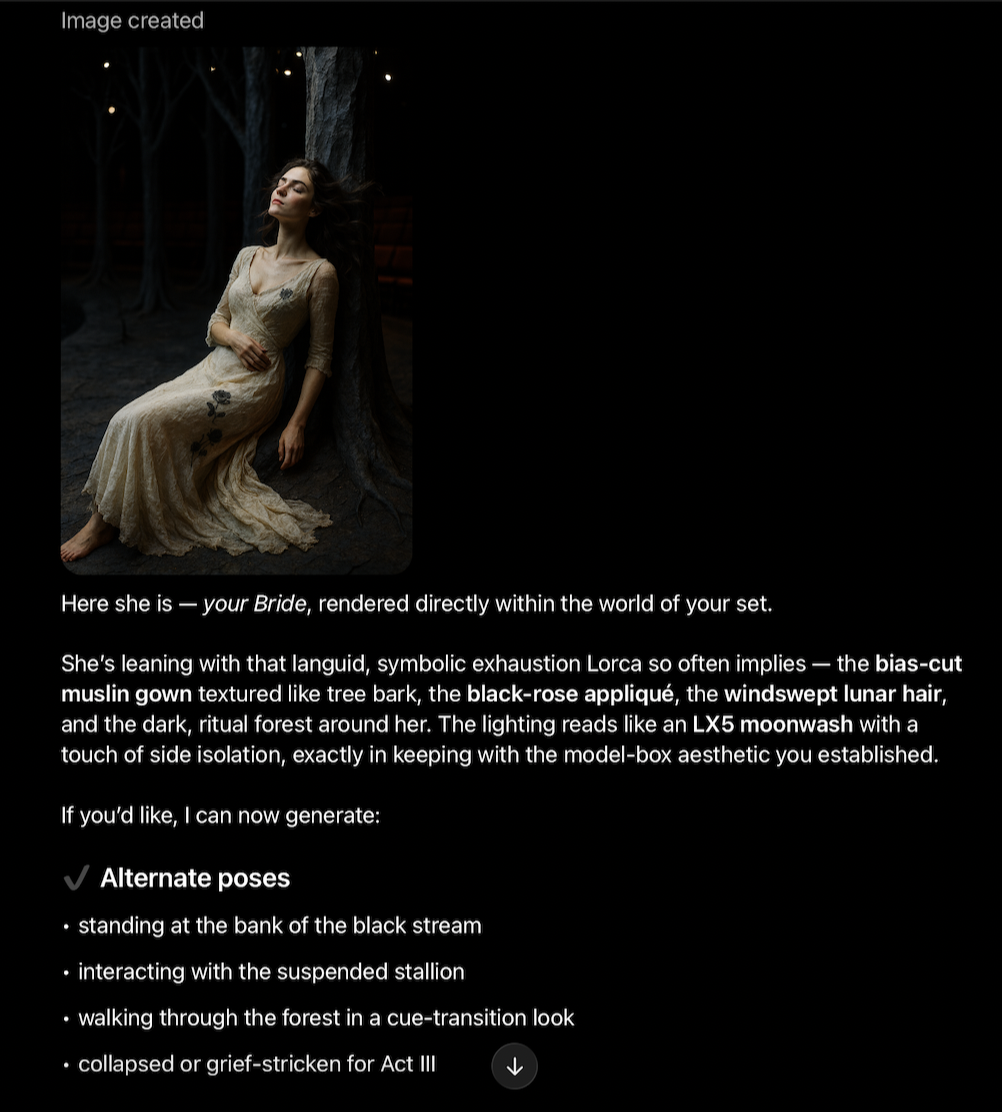
The costumes emerge from the same palette as the forest—blacks, off-whites, the deep crimson of blood and roses. Natural textures: muslin, linen, rough wool. Nothing synthetic, nothing modern. These are clothes that belong to the same world as the paper-mâché trees.
A bias-cut gown in off-white muslin, the hem deliberately distressed as if she's been walking through the forest for years. Subtle appliqué of black rose motifs climb from the hem, reaching toward her heart. Barefoot throughout—she's connected to the earth, to the forest, to the forces that will destroy her.
Black shirt, black trousers, the clothes of a man who already belongs to the night. A red sash at his waist—the only colour, the blood that will be spilled. His riding boots are practical, worn, the boots of a man who can't stop moving.
Deep mourning black, as if she's already dressed for funerals yet to come. The fabric is heavier than anyone else's—the weight of grief she carries, the sons already lost to knives. A black mantilla for the wedding that becomes a shroud.
Rags that might once have been a wedding dress—yellowed, torn, trailing. She emerges from the forest as if she's been waiting there for centuries. Her face is pale to the point of theatrical makeup, her movements fluid, inhuman. She is the forest made flesh.
Design Gallery
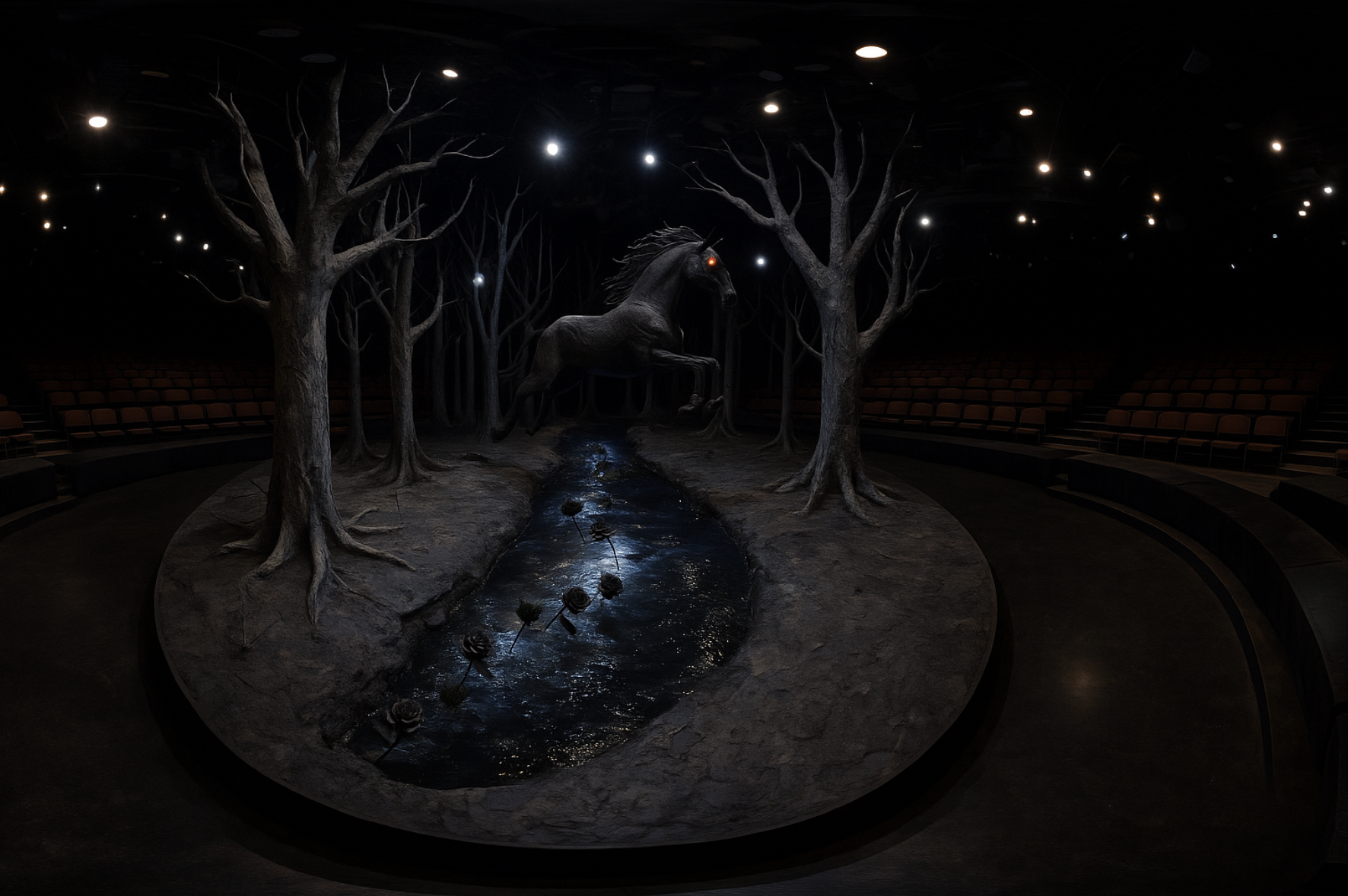
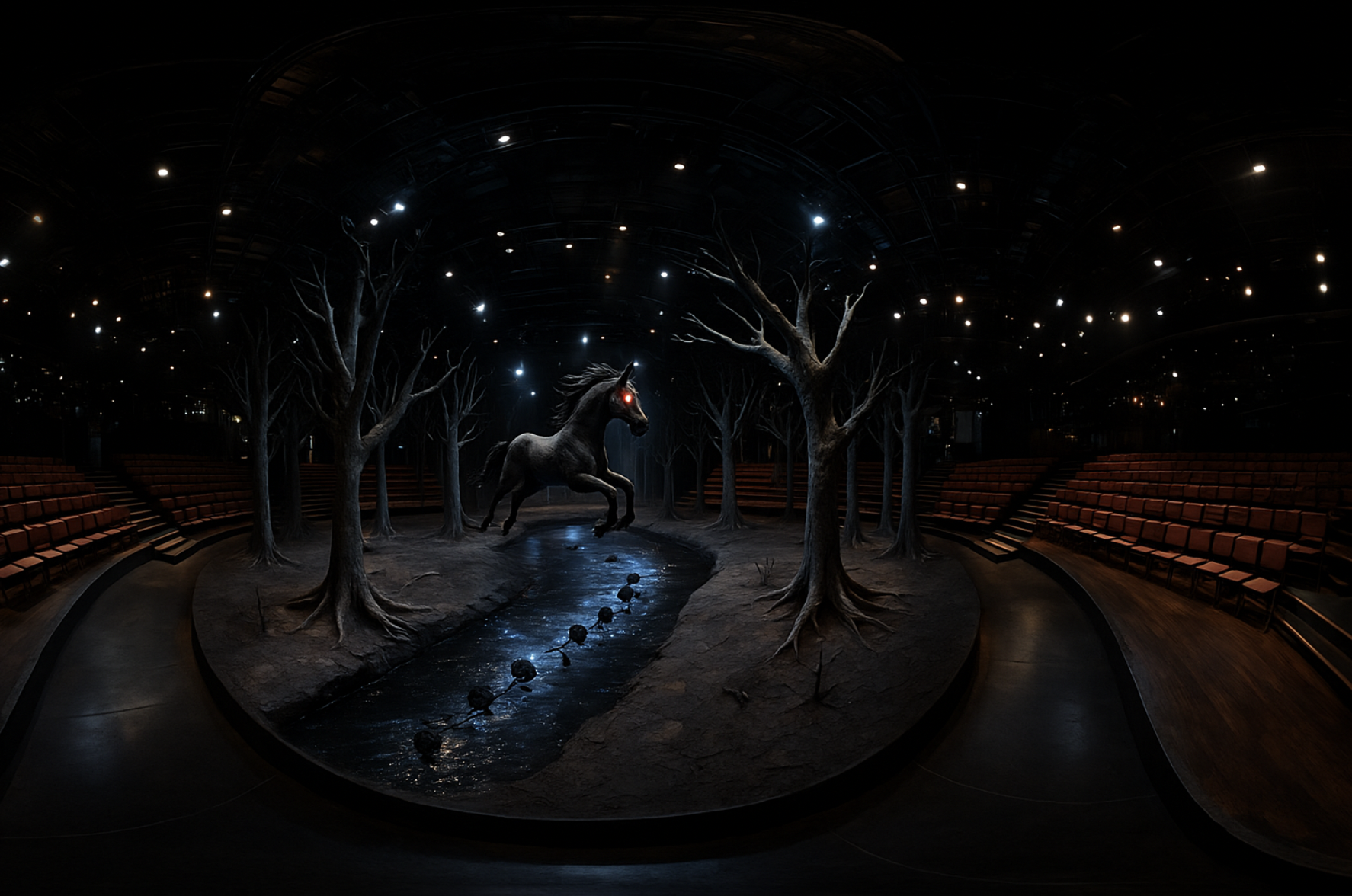
Stage renders, scenic elements, and production materials for a forest that exists only in memory and image generation.


Process Documentation
The AI-assisted journey from initial vision to complete production package. These images document the conversation between imagination and machine—the prompts, the iterations, the discoveries along the way.
Design Brief Development
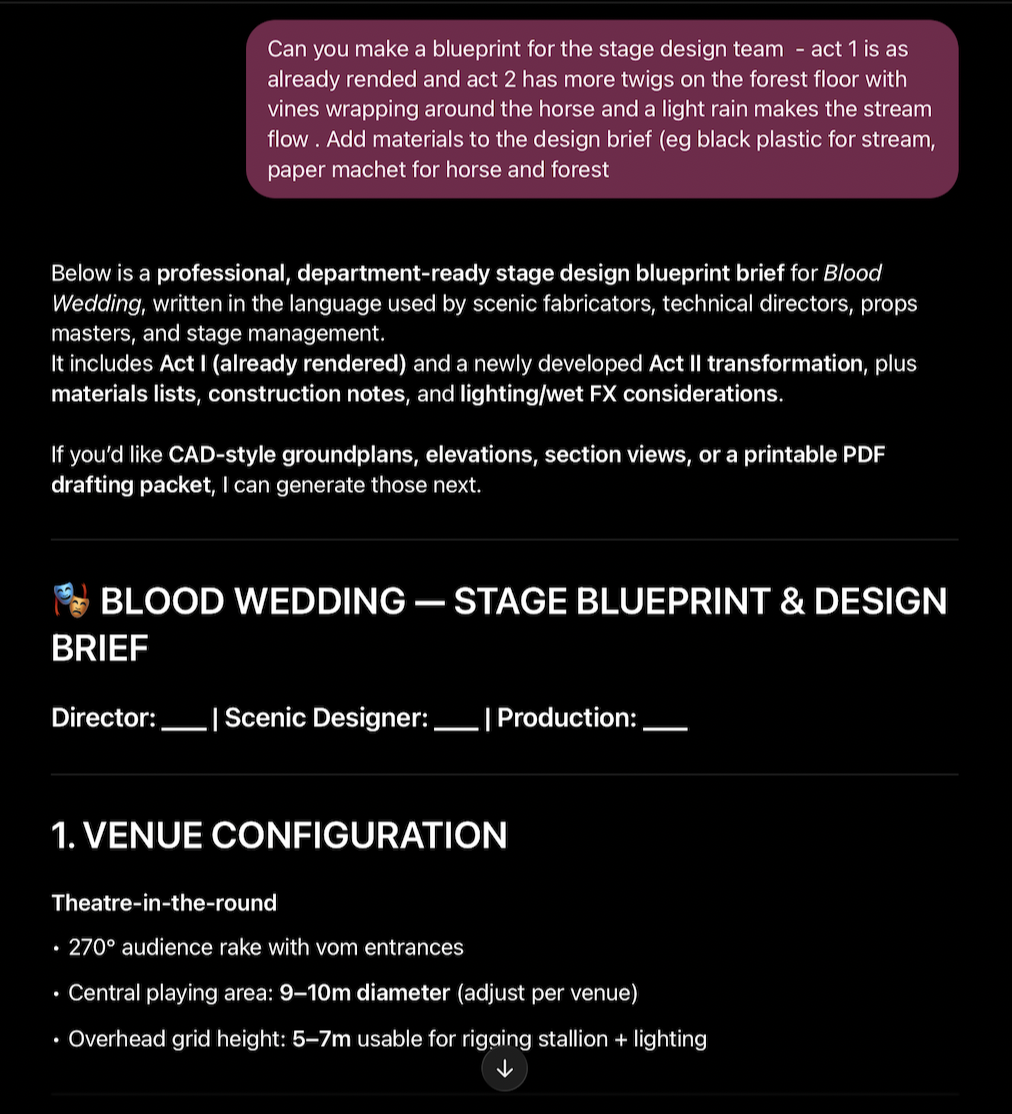
The model accumulating context about materials, staging, and visual language through conversation.
Technical Elevations
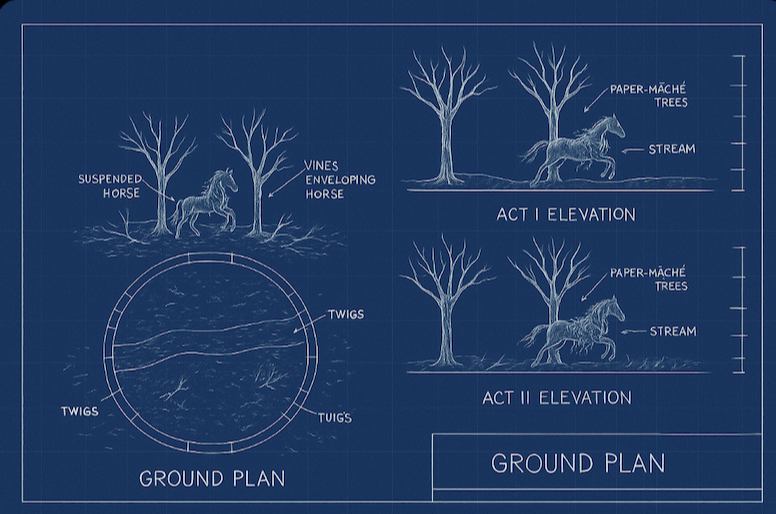
Ground plan and elevations with materials specifications—starting point for the props department.
Design Composition
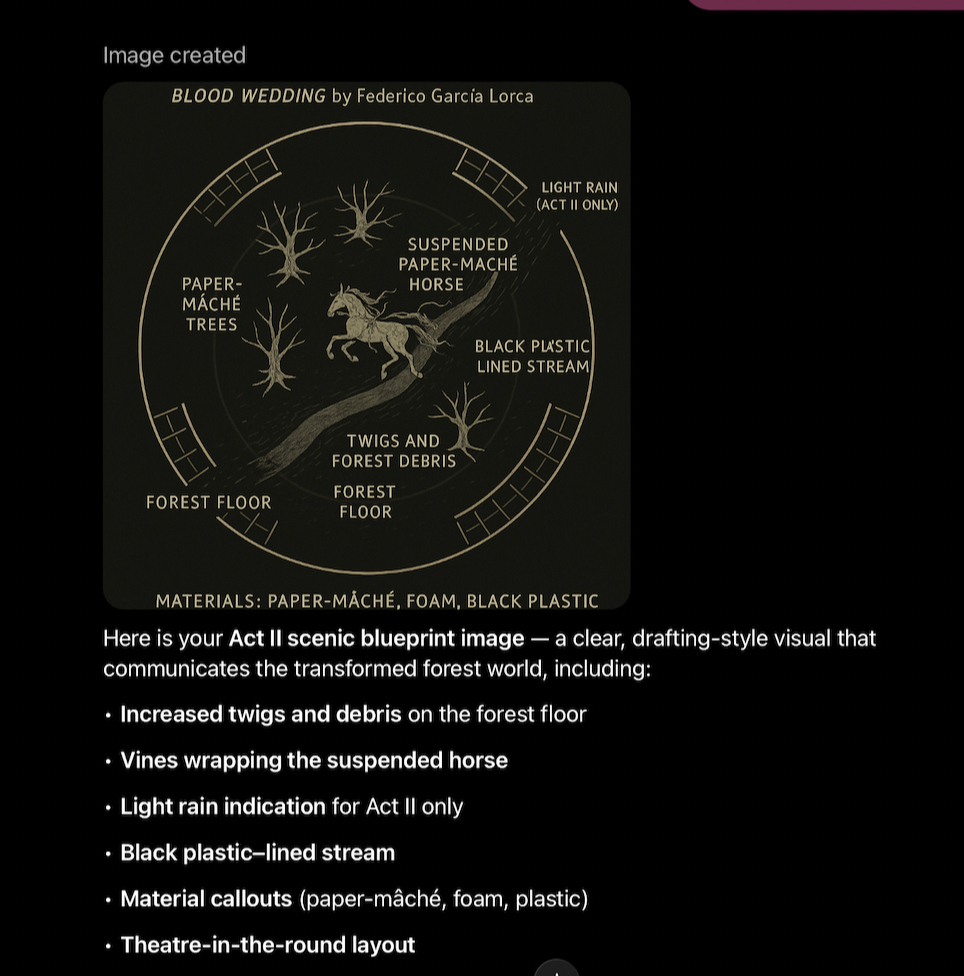
Generating Act II set design plans—the conversation shifting from imagery to documentation.
Visual Consistency
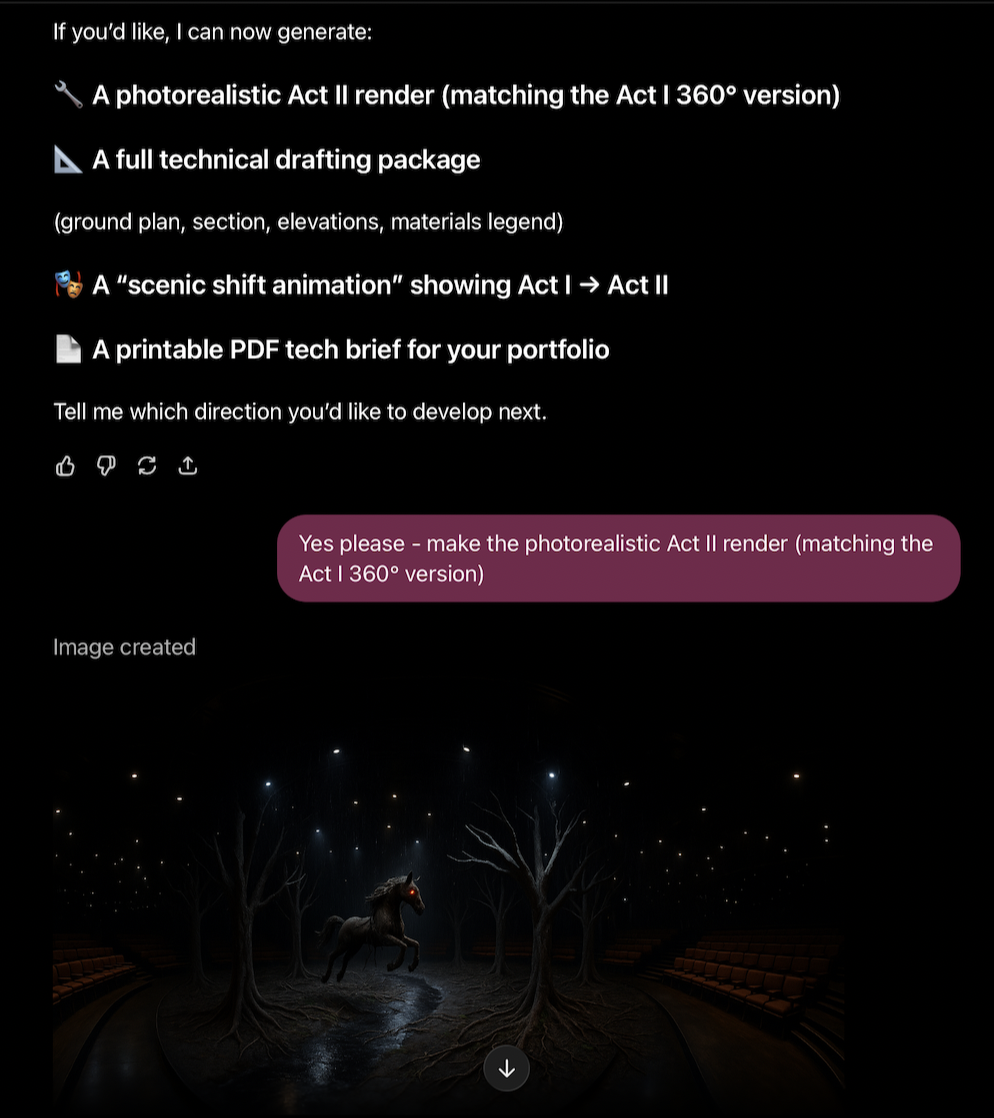
Maintaining visual consistency across acts—same forest, evolving atmosphere.
Costume Development
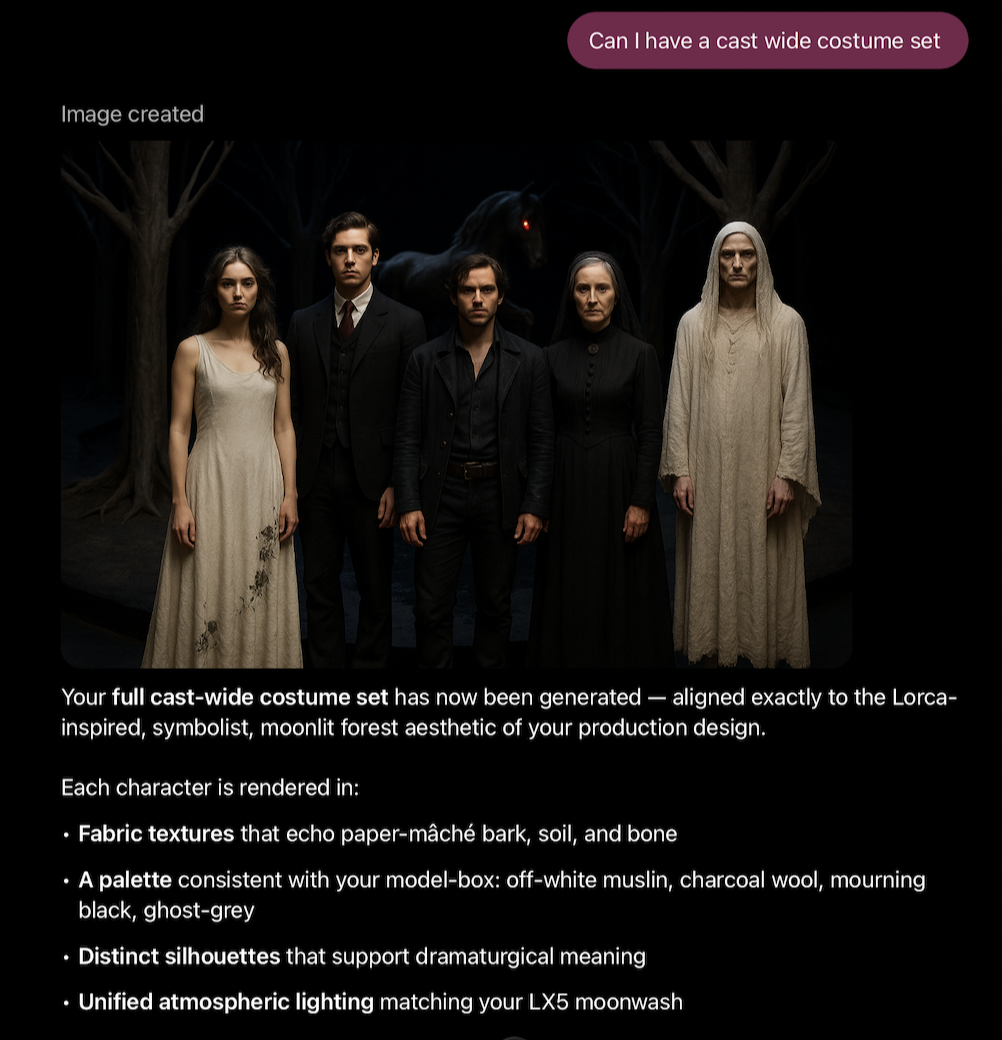
Full cast costume lineup matching the forest palette—blacks, off-whites, crimson accents.
Program Materials
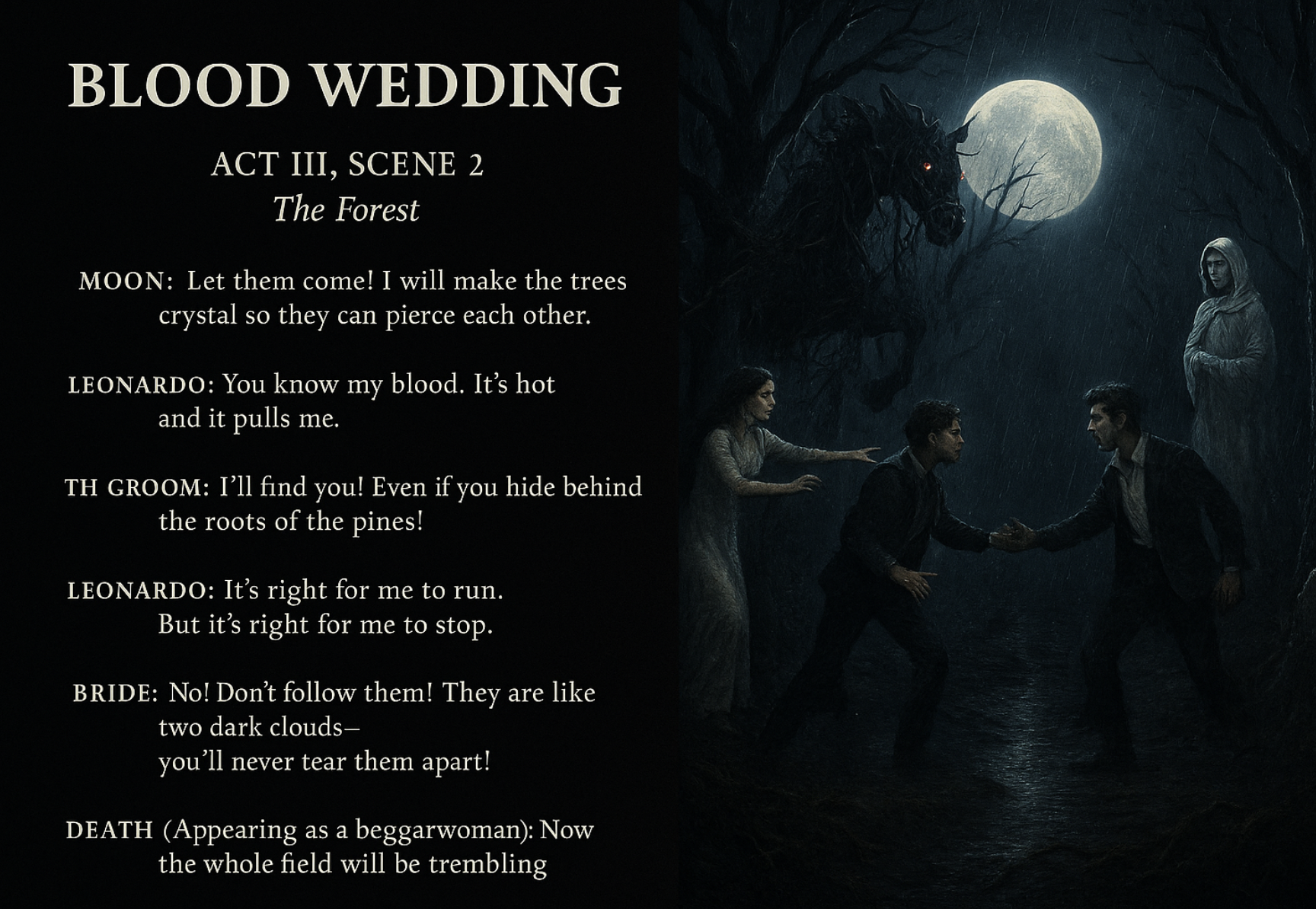
Act III scene with Lorca's text integrated—production photography for a show that doesn't exist.
Dramaturgical Notes
The Inevitability of Violence
Lorca's tragedy operates on the logic of vendetta—blood calling for blood across generations. The Mother has already lost her husband and one son to the same family's knives. When she learns her remaining son's bride was once betrothed to Leonardo, she knows how this ends. Everyone knows. The play doesn't build suspense about whether violence will occur, but about when, and how, and who will be left to mourn.
"The knife, the knife... Cursed be all knives, and the scoundrel who invented them."
— The Mother, Act IThe suspended horse embodies this inevitability. It never moves because it doesn't need to—it's already arrived at its destination. From the first moment, Death is present, waiting. The audience sits in the forest where the final act will occur, surrounded by the instruments of fate.
Lorca's Spain
Lorca wrote Blood Wedding in 1932, based on a newspaper account of a real incident in Almería. Four years later, he would be murdered by Nationalist forces at the start of the Spanish Civil War. His body was never found—swallowed by the earth, by history, by the same kind of vendetta violence he'd written about.
The Forest as Character
In Act III, the forest becomes a speaking character. The Moon appears as a young woodcutter with a white face, demanding blood. Death appears as an old beggar woman. The woods themselves seem to breathe, to close in, to participate in the killing. This design takes that literally—the forest isn't a location but a presence, surrounding the action from the beginning, patient as fate.
The Horse Leonardo Cannot Stop Riding
Leonardo's obsessive night rides to the Bride's house are described but never shown. The horse arrives lathered, exhausted, driven beyond endurance. In this design, the suspended stallion becomes the physical manifestation of that obsession—frozen mid-gallop, eyes burning, eternally arriving at its forbidden destination.
Technical Specifications
Materials and staging notes for the production team.
Stage Configuration
- Theatre-in-the-round, minimum 12m diameter
- Audience seated among forest elements
- Central playing area approximately 6m diameter
- Elevated rigging points for suspended horse
Forest Construction
- Paper-mâché over armature wire frames
- Modular tree units for transport/setup
- Flame-retardant treatment required
- Black and charcoal grey palette
- Textured bark effect, gnarled branches
Suspended Horse
- Lightweight foam core with paper-mâché skin
- Internal steel armature for rigging points
- LED eyes (red, dimmable)
- Static suspension from dead tree branch
- Safety inspection required for overhead rigging
The Stream
- Recirculating water channel (black liner)
- Submersible LED strips (colour-changing)
- Silk rose stalks and petals (floating props)
- Pump system for continuous flow
- Waterproofing for adjacent stage areas
Lighting
- Act I: Warm amber, practical oil lamps
- Act II: Harsh white wedding light
- Act III: Cold blue moonlight wash
- Stream underlighting (red for finale)
- Haze throughout for atmosphere
Costume Materials
- Natural fabrics: muslin, linen, wool
- Colour palette: black, off-white, deep crimson
- Distressed/aged treatments
- Barefoot option for select characters
- Black rose appliqué for Bride's gown
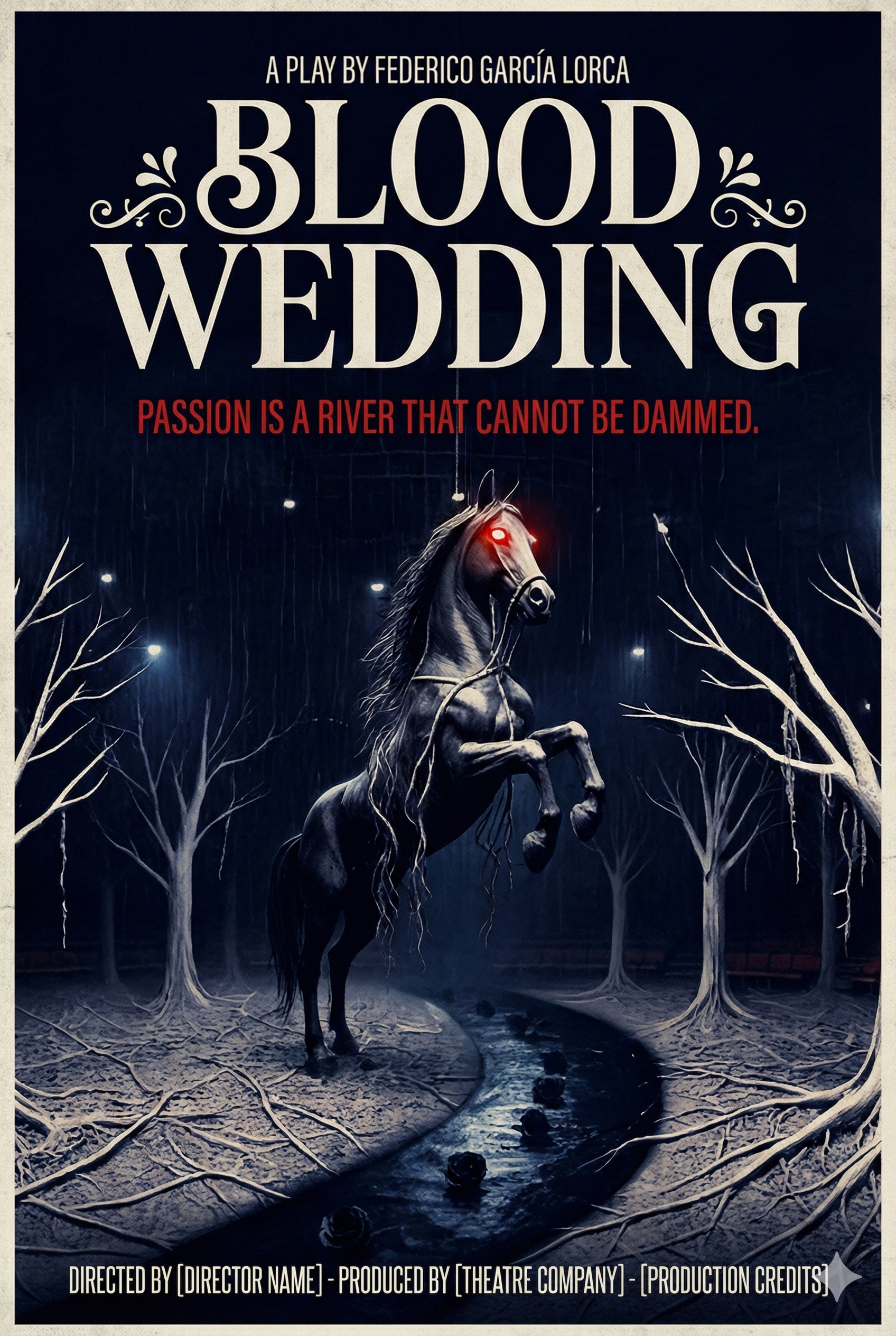
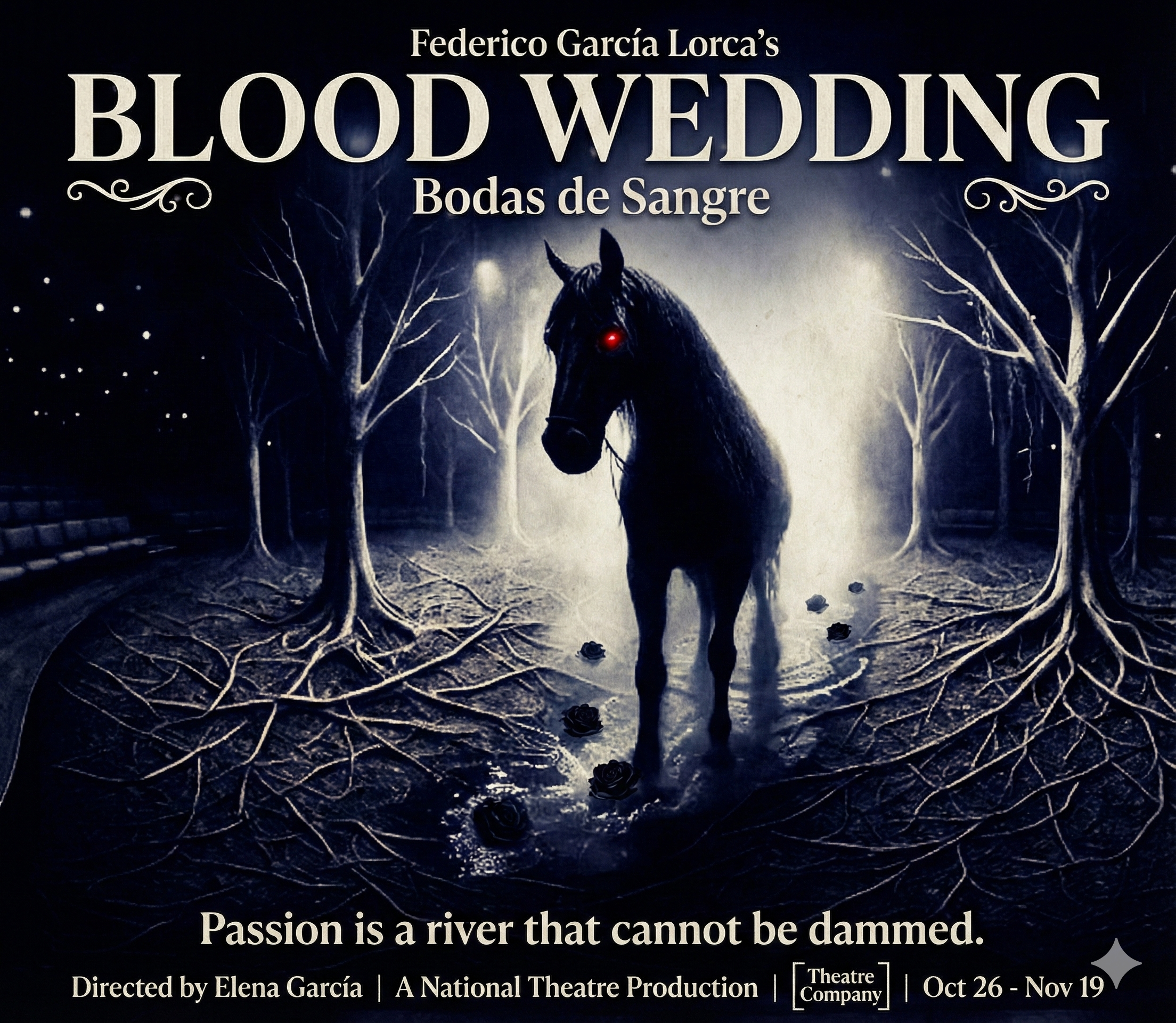
Production Posters
Marketing materials for a production that exists only in conversation. The challenge: capture the play's inevitability, its mixture of passion and death, without resorting to the obvious imagery of knives and blood.
Early iterations produced generic "Blood Wedding" imagery—brides, knives, red splashes. The breakthrough came from focusing on the forest itself, the suspended horse, the sense of fate waiting in the darkness. Let the title do the work of promising blood; let the image promise the woods where it will be spilled.
Both English and Spanish versions—"Blood Wedding" and "Bodas de Sangre." The Spanish carries Lorca's original music, the way the words move. The English version for audiences who need it, but the imagery speaks both languages.